
First-in-human phase Ia/Ib study of RS-0139, an integrin-targeted docetaxel prodrug, in advanced solid tumors
ESMO Congress 2026, Madrid, Spain | ePoster 1095eP
23-27 October 2026
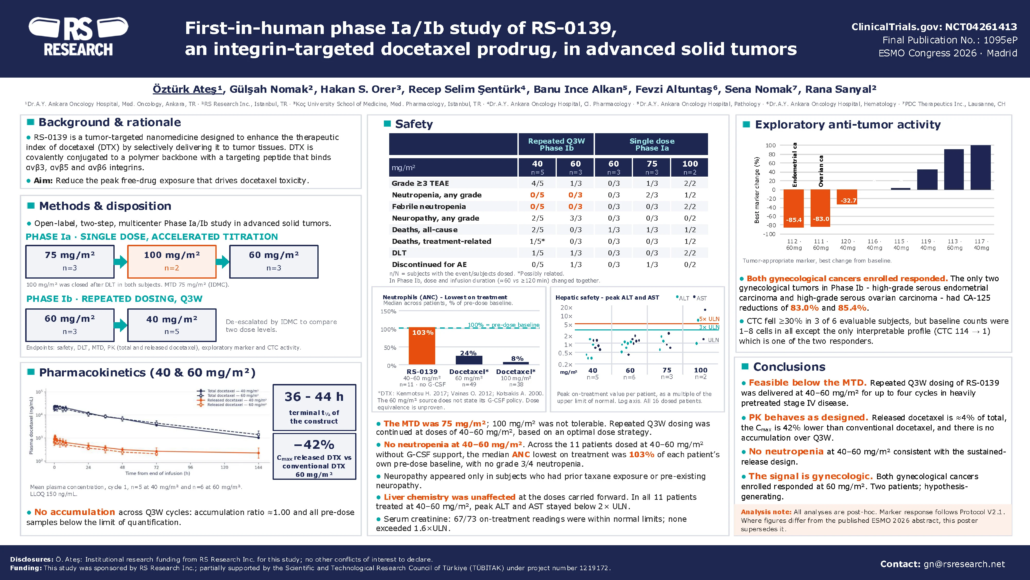
The figures on this page are from the final ePoster, which reports updated post-hoc analyses. Where they differ from the published abstract, the ePoster supersedes the abstract.
Authors
Öztürk Ateş¹, Gülşah Nomak², Hakan S. Orer³, Recep Selim Şentürk⁴, Banu İnce Alkan⁵, Fevzi Altuntaş⁶, Sena Nomak⁷, Rana Sanyal²
Affiliations
¹ Dr. Abdurrahman Yurtaslan Ankara Oncology Training and Research Hospital, Medical Oncology, Ankara, Türkiye
² RS Research, Istanbul, Türkiye
³ Koç University School of Medicine, Medical Pharmacology, Istanbul, Türkiye
⁴ Dr. Abdurrahman Yurtaslan Ankara Oncology Training and Research Hospital, Ankara, Türkiye
⁵ Dr. Abdurrahman Yurtaslan Ankara Oncology Training and Research Hospital, Pathology, Ankara, Türkiye
⁶ Dr. Abdurrahman Yurtaslan Ankara Oncology Training and Research Hospital, Hematology, Ankara, Türkiye
⁷ PDC Therapeutics, Lausanne, Switzerland
Background
RS-0139 is a tumor-targeted nanomedicine designed to improve the therapeutic index of docetaxel (DTX) by modifying its systemic exposure and selectively delivering the payload to tumor tissues.
Developed using RS Research’s proprietary Sagitta® targeted drug delivery technology, RS-0139 consists of docetaxel covalently conjugated to a polymer backbone equipped with a targeting peptide that binds αvβ3, αvβ5 and αvβ6 integrins.
The development objective is to reduce peak exposure to released docetaxel associated with conventional chemotherapy toxicity, while maintaining the potential for antitumor activity.
Methods
RS-001 is a first-in-human, multicenter, open-label, two-step Phase 1a/1b study in patients with advanced solid tumors. Endpoints were safety, tolerability, dose-limiting toxicities (DLTs), maximum tolerated dose (MTD), pharmacokinetics (PK) and exploratory antitumor activity.
The study enrolled 16 patients, including eight in Phase 1a single-dose escalation and eight in Phase 1b repeated dosing every three weeks (Q3W). Phase 1a evaluated 75 mg/m² (n=3), 100 mg/m² (n=2) and 60 mg/m² (n=3). Phase 1b evaluated repeated dosing every three weeks (Q3W) at 60 mg/m² (n=3) and 40 mg/m² (n=5), after the independent data monitoring committee (IDMC) de-escalated the dose, to compare two dose levels. Patients in Phase Ib received up to four cycles. In Phase Ib, dose and infusion duration (approximately 60 vs ≥120 minutes) changed together.
Exploratory assessments included tumor-appropriate markers and circulating tumor cells (CTCs).
Results
Dose determination and safety
The MTD was established at 75 mg/m². 100 mg/m² was closed after DLTs in both patients. Repeated Q3W dosing was continued at 40-60 mg/m².
No neutropenia of any grade was observed among the 11 patients treated at 40-60 mg/m², including the Phase 1a 60 mg/m² cohort and Phase 1b cohorts, without G-CSF support. The median lowest on-treatment absolute neutrophil count (ANC) was 103% of pretreatment baseline. The poster also shows published conventional-docetaxel reference values of 24% and 8% at 60 and 100 mg/m², respectively. These are indirect comparisons; dose equivalence is unproven and the DTX 60 mg/m² source does not state its G-CSF policy.
Neutropenia occurred in 2/3 patients at 75 mg/m² and 1/2 at 100 mg/m²; febrile neutropenia occurred in both patients at 100 mg/m². Neuropathy was reported in 5/8 Phase Ib patients (2/5 at 40 mg/m², 3/3 at 60 mg/m²), only in patients with prior taxane exposure or pre-existing neuropathy.
Across all 16 patients, grade ≥3 treatment-emergent adverse events were recorded in 8/16 patients and DLTs in 4/16 patients. Two patients discontinued for adverse events. All-cause deaths were reported in 5/16 patients. Two deaths were assessed as treatment-related: one possibly related at 40 mg/m² and one at 100 mg/m².
At 40-60 mg/m², peak ALT and AST remained below twice the upper limit of normal in all 11 patients. Serum creatinine was within normal limits in 67 of 73 on-treatment measurements, with none exceeding 1.6 times the upper limit of normal.
Pharmacokinetics
The RS-0139 construct showed a terminal half-life of 36-44 hours. Released docetaxel accounted for approximately 4% of total measured docetaxel. At 60 mg/m², peak plasma concentration (Cmax) of released docetaxel was 42% lower than a conventional docetaxel reference (cross-study comparison).
No accumulation was observed across Q3W cycles, with an accumulation ratio of approximately 1.00 and all predose samples below the limit of quantification.
Exploratory antitumor activity
Two heavily pretreated patients with gynecological cancers enrolled in Phase 1b showed marked CA-125 reductions: 83.0% in a patient with endometrial carcinoma and 85.4% in a patient with ovarian carcinoma.
CTC reductions of at least 30% were also observed in 3 of 6 evaluable patients. Baseline counts were 1–8 cells in all but one patient, whose profile (114 → 1 cells) was the only interpretable one and belonged to one of the two gynecological responders.
These exploratory observations are hypothesis-generating and do not establish objective radiographic responses or clinical efficacy.
Conclusions
The Phase 1a/1b study established a dose range for continued investigation of RS-0139. Repeated Q3W dosing at 40–60 mg/m² was feasible for up to four cycles in heavily pretreated stage IV disease, with no neutropenia at these doses and a pharmacokinetic profile consistent with the intended sustained-release design. Exploratory marker responses were observed in both gynecological cancers enrolled.
As RS Research’s lead clinical program developed using Sagitta®, the study contributes to the clinical evidence base for the company’s broader targeted drug delivery platform family. Further studies are needed to establish the therapeutic benefit, overall safety and optimal clinical applications of RS-0139.
Citation
Annals of Oncology (2026) 37 (suppl_3): S769-S850. 10.1016/annonc/annonc2193
Clinical trial identification
RS-0139 is an investigational medicine evaluated in an early-stage, non-randomized clinical study, and has not been approved by any regulatory authority. All analyses presented are post-hoc.

